
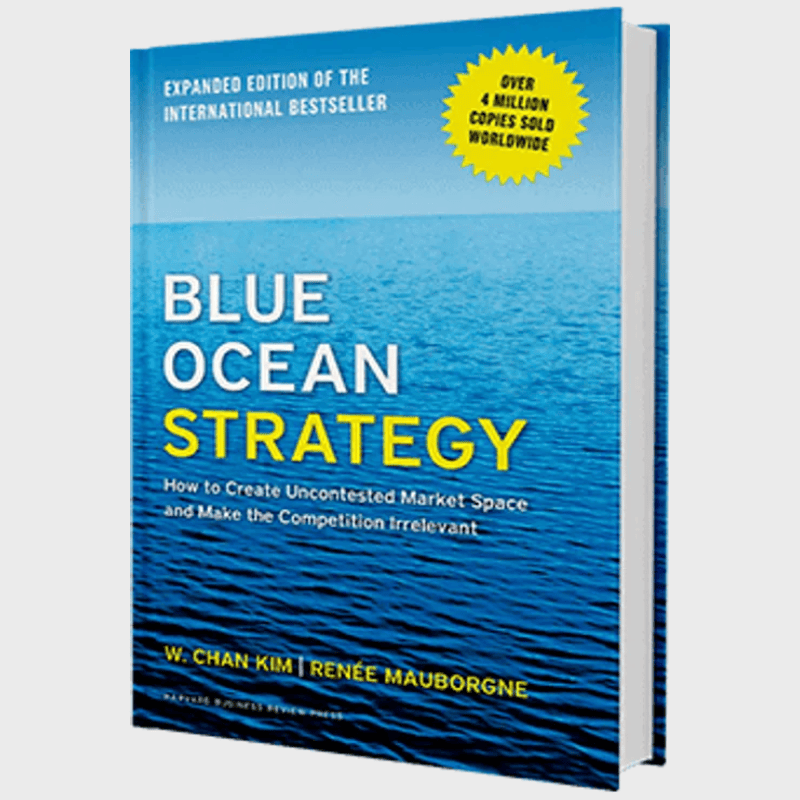
blue oceans strategies
**Blue Ocean Strategy** by **W. Chan Kim** and **Renée Mauborgne**.
The title uses "ocean" as a metaphor, where **red oceans** represent known market spaces filled with **struggles** and cutthroat competition for shrinking profits,
while **blue oceans** represent uncontested, untapped market spaces ripe for growth.
Product Description
The authors argue
that companies should not fight for market share in bloody red oceans but instead create blue oceans through **value innovation**. This approach focuses on making the competition irrelevant by reconstructing market boundaries and creating new demand rather than battling existing rivals.
**Blue Ocean Strategy**
is a business framework developed by **W. Chan Kim** and **Renée Mauborgne** that directs companies to create uncontested market space ("blue oceans") rather than competing in saturated markets ("red oceans"). The core principle is **value innovation**, which involves simultaneously pursuing differentiation and low cost to make competition irrelevant.
Key components include:
* **Value Innovation**: Breaking the traditional trade-off between value and cost to offer unique benefits while reducing expenses.
* **Four Actions Framework**: A tool to reconstruct market boundaries by determining which industry factors to **Eliminate**, **Reduce**, **Raise**, or **Create**.
* **Strategy Canvas**: A visual diagnostic tool to map current industry competition and identify opportunities for differentiation.
* **Non-Customers**: Focusing on creating demand among non-customers rather than fighting for existing market share.
Notable examples of Blue Ocean Strategy include **Cirque du Soleil**, which combined circus and theater to attract a new adult audience; **Netflix**, which created the streaming market by eliminating late fees and physical stores; and the **Nintendo Wii**, which focused on innovative motion controls rather than competing on high-performance graphics.